The Paper Lantern’s Move from Festival Object to City Image
See how paper lanterns shift from working festival objects to city imagery, and learn how to read a display’s setting, activity and organisers with care.
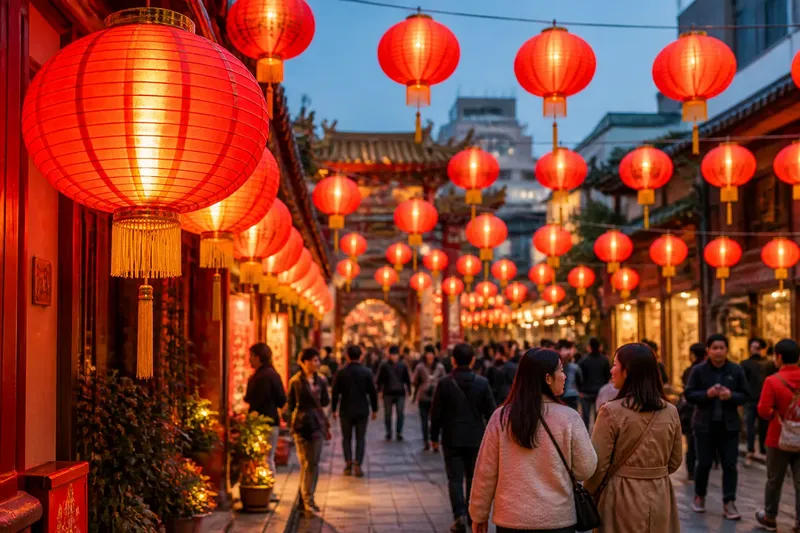
At dusk, a row of red paper lanterns turns a shopping lane into a glowing corridor. To read the shift from festival object to city image, look beyond the colour: ask where the lanterns hang, who arranged them and what people are doing nearby. The same warm light can mark a gathering, frame a public event or lend a street a familiar look.
Those roles can overlap. A display may welcome visitors while remaining part of a local celebration; another may echo festival imagery without serving the same custom. A careful reading begins with what is visible, then checks the local signs and activity before assigning a meaning.
What makes a paper lantern part of a festival?
A lantern becomes a festival object through its relationship to an occasion and the people taking part, not simply through its shape. Paper stretched over a light frame might be carried by hand, suspended above a route or placed in a gathering space. Materials and construction vary, so no single design stands for every custom across eastern Asia.
Look for a practical or ceremonial role. Lanterns might accompany a procession, mark an entrance or contribute to a seasonal gathering. Their colour, pattern and placement may matter locally, but a familiar red globe alone cannot identify a festival or its meaning.
What should you notice around a lantern display?
Start at the edges rather than the brightest point. Do the lanterns lead towards a gathering place, hang along a route or cluster around an entrance? Are people carrying or tending them, or do they remain fixed overhead as a backdrop?
Then look for organisers and context. A temple, neighbourhood association, festival committee, shopfront or municipal arts team may shape a display, each with a different purpose. Commerce and photography do not automatically make a celebration less meaningful, but they are reasons to look for more context.
- Check the route: If lanterns lead towards a gathering or procession, describe them as part of that route; if they simply frame a street, describe the streetscape instead.
- Check for handling: If people carry, light, replace or gather lanterns, note that active use; if the objects remain fixed, describe them as a static display.
- Check the setting: If lanterns surround a shrine, civic square or event entrance, name that setting; if they line a shop arcade, describe the commercial street context.
- Check the schedule: If a dated event notice links the display to a celebration, name that occasion; if no event is advertised, call it a seasonal or street display rather than assuming a festival.
- Check the accompanying words: If a local sign names organisers or a custom, use that wording with care; if it gives no explanation, stick to what you can see.
- Check the materials at close range: If you can see paper and a light frame, describe paper lanterns; if the surface is rigid or weather-resistant, use the broader term “lantern-shaped lights” unless a sign identifies them.
These checks are clues, not a test with one correct answer. They help you describe a scene without assigning a custom to a community on the strength of colour or shape alone.
How do lanterns become part of a city’s image?
When lanterns move from a particular occasion into streetscape design, their visual role can broaden. They may be repeated along a commercial road, hung over a pedestrian area or installed as seasonal decoration. From a distance, that familiar line can help visitors recognise a district, even when the display is not tied to a current event.
There is no single story behind this change. Neighbourhoods and cities select and adapt visual signs for their own histories and present-day uses. Paper lanterns may appear in public art, visitor attractions, festival lighting or everyday shopfront decoration. Some displays remain closely linked to local celebrations; others use the lantern’s recognisable form to create a festive atmosphere.
The material can change as well. A display might use paper, lantern-shaped lights made from other materials or a mixture chosen for outdoor use. The silhouette may stay familiar while the object’s construction and purpose differ. A glowing globe is not necessarily a handmade festival lantern.
How can you read a contemporary display?
Ask what the arrangement invites you to notice: a historic lane, shopping district, seasonal celebration, civic space or photo backdrop. Then compare that invitation with the activity around it. Are people attending a programme, passing through or stopping briefly for photographs?
Say you arrive at a pedestrian street lined with red lanterns. An entrance sign advertises an evening arts programme, performers are active beneath the display and visitors gather to watch. You can describe the lanterns as framing a live event as well as giving the street a distinctive look. If you return after the programme has ended and the lights remain fixed overhead, the visible emphasis has shifted towards streetscape decoration. The sign and activity give you grounds for the first description; the later scene supports the second, without revealing every organiser’s intention.
A photograph also leaves things outside its frame. A neat row may make a striking image while showing little of the work involved in hanging or maintaining it. Look for an event notice, entrance or wider street view before treating one picture as a complete account.
How can you photograph lanterns without flattening the occasion?
Choose a view that shows how the lanterns relate to their setting. A close-up can record the paper’s texture and seams; a wider frame can include a route, entrance or gathering. Give people space, and follow any signs or requests about photography, especially at religious or community events.
For evening pictures, steady a phone against a wall or railing and check the screen for lanterns that have turned into blank white patches. If they have, change your angle or let the glowing centre remain bright rather than trying to reveal every surface detail. A sharp lantern with some motion in the crowd can convey the atmosphere better than an empty-looking frame.
If you share the picture, include the location and occasion when you know them. “Lanterns in a city street” describes the subject; a district name or event sign can add context. If the custom is unclear, say so rather than supplying a meaning the scene has not established.
What do visitors often ask about paper lanterns?
Are all red paper lanterns tied to the same festival?
No. Colour alone does not identify an event, community or meaning. Check local wording, organisers and surrounding activity before naming a tradition.
Does a display stop being a festival custom when visitors take photographs?
No. Photography can accompany a continuing celebration, while a display arranged chiefly for visitors may have another purpose. Look at who participates and what happens around the lanterns rather than treating photographs as proof either way.
How can I tell paper lanterns from lantern-shaped street lights?
At close range, paper may show a surface and seams over a lightweight frame, while other installations can use rigid or weather-resistant materials. If the materials are not visible, check for a display notice or describe the objects more generally.
Can I call a display traditional?
Use “traditional” when the event’s own explanation or a reliable local description supports that word. Otherwise, describe the visible scene, such as paper lanterns above a street or lights arranged across a square.
What details help distinguish custom from city image?
Before leaving, look beyond the brightest section. Do the lanterns end at a doorway, continue into the neighbourhood or stand alone as an installation? That wider view can help you distinguish a route or event setting from a display designed mainly to shape the appearance of a public space.
The shift from festival object to city image is not always a clean break. One display can serve a gathering and shape a streetscape at once; another can echo a familiar form without belonging to the same practice. Read the setting, activity and local explanation together, and the lanterns become more than a backdrop: they offer clues to how a place presents itself.