Why a Covered Arcade Changes the Pace of a Market Street
A covered arcade changes a market street by shaping shelter, movement and pauses. Learn what to notice without treating one layout as universal.
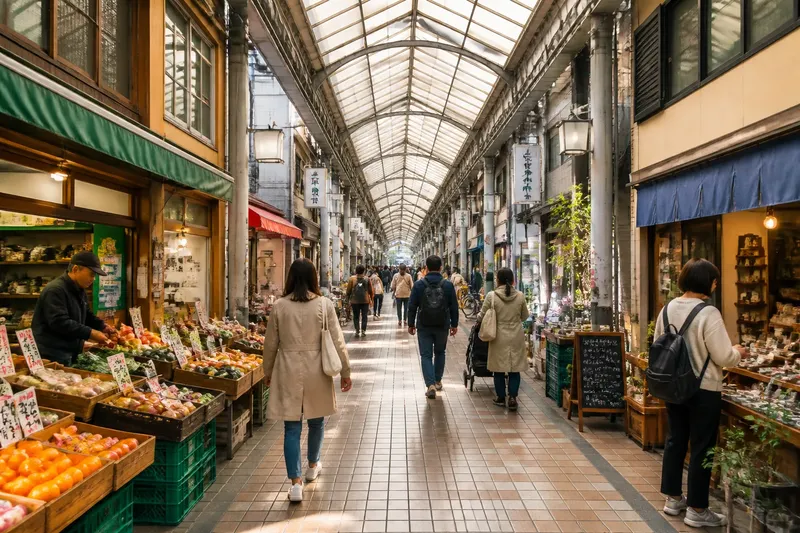
On a market street, a sudden shower can send shoppers beneath the same long roof, where footsteps slow and shopfronts come into sharper view. A covered arcade changes the pace of a market street not simply by keeping rain off, but by giving movement a continuous edge: people can drift, stop, and start again without stepping out of the sheltered route.
How does a covered arcade change the way people move?
The roof creates a legible path. Instead of deciding at every doorway whether to cross an exposed stretch, a passer-by can follow the arcade along the shopfronts. That continuity can make walking feel less interrupted, particularly where weather, strong sun or passing traffic would otherwise pull attention away from the street.
But a covered route does not automatically make people walk faster. A clear, broad passage may carry through-traffic smoothly; a narrow one, or one crowded with displays, can encourage a slower, more careful pace. The roof establishes a shared corridor, while its width, surface, columns and everyday uses determine how freely people can move within it.
Imagine a shopper arriving on a dry afternoon with a folded list of groceries. If a fruit stall has placed baskets near the arcade’s edge, the shopper may slow to look while leaving room for others to pass. The observable result is a brief pause along the route rather than a complete stop in its middle. Move the baskets into the centre and the same pause can become a pinch point.
Why do people pause beneath the roof?
Shelter gives stopping a practical reason. Someone can check a shopping bag, wait for a companion, study a handwritten price board or decide which doorway to enter without immediately confronting the weather. The arcade makes these small pauses part of the street’s ordinary use, rather than events that require a separate destination.
Shopfronts also reward a slower glance. Under a continuous roof, signs, open counters and displays can form a sequence at eye level. A shopper might notice a repair shop, then a grocer, then a place selling household goods simply by continuing along the same sheltered line. The visual rhythm comes from repetition and variation together: similar bays create a beat, while different trades interrupt it.
There is a limit. A bench, display or queue can turn a convenient pause into an obstruction if the passage is tight. An arcade works as shared public space only when people who are browsing, carrying bags, pushing prams or moving through can make room for one another. The most sociable-looking spot is not always the easiest place to stop.
What makes the arcade’s visual rhythm feel different?
Look up and along, not only at the individual shops. Repeated supports, roof joints or hanging signs can draw the eye towards a distant bend. The pattern may make a long street feel like a sequence of manageable stretches rather than one exposed vista. Changes in ceiling height, light and shopfront depth add variation without breaking the sheltered path.
At ground level, the edge between passage and business is often where the street comes alive. A shop may open its counter towards the walkway; another may keep its goods inside, with only a sign or doorway visible. These contrasting thresholds set a visual tempo: open, enclosed, open again. They also give walkers reasons to adjust their pace, though local habits and the mix of businesses matter as much as the roof.
Notice what the structure frames as well as what it covers. A gap between roof sections may reveal the sky; a side lane may offer a view towards a station or a market square. Such openings can help people orient themselves and prevent the arcade from reading as a sealed tunnel. In other places, a more enclosed roof may be valued for the shade and shelter it provides.
What should you notice when walking through a covered arcade?
A useful way to read one is to watch how the route is shared at different points, rather than judging the design from a single photograph. Notice what happens near entrances, busy counters and changes in the roof. These details show where the arcade supports browsing and where through-movement takes priority.
- Follow the roofline. Does the shelter continue across intersections and side entrances, or end abruptly?
- Check the walking surface. Is the route even and clear, or do thresholds and displays make people change course?
- Watch the edges. Where do queues form, and can passers-by get around them?
- Compare light and shade. Do bright openings help orient you, or do dark sections make the route harder to read?
- Look at shopfronts. Are counters and signs visible from the passage, or does activity sit further inside?
- Notice other users. Can people walking at different speeds share the space without constant dodging?
These observations are more useful than labelling an arcade successful or unsuccessful at a glance. A layout that suits a compact shopping lane may feel crowded on a street with heavy passing traffic; an open-sided roof may fit a mild climate better than a more enclosed structure. The question is what the arrangement invites people to do, and who can comfortably use it.
Does every covered arcade make a street more welcoming?
No. A roof can offer shelter while leaving other barriers untouched. A passage with awkward steps, cluttered edges or confusing entrances may remain difficult to use. Equally, a bright open arcade can feel inviting to one person and exposed to another. The effect depends on details of access, maintenance, trade and local routines, not on the presence of a roof alone.
It also matters who controls the space and how its edges are used. Some arcades are lively because shopkeepers display goods or customers linger; others need a clearer through-route for people heading elsewhere. Neither pattern is universal. A street’s character comes from the way its physical form meets the daily choices of residents, traders and visitors.
What do visitors often ask about covered market arcades?
Is a covered arcade the same as a shopping mall?
Not necessarily. An arcade may remain visibly part of an ordinary street, with public entrances, separate shopfronts and open connections to nearby lanes. Its roof provides a shared sheltered route, but the setting and management can differ from those of an enclosed retail complex.
Can an arcade still feel like a public street?
It can, especially where the walkway connects directly to surrounding streets and people use it for more than entering shops. Open edges, visible side routes and room to pass can preserve a sense of connection, though actual access arrangements vary from place to place.
Why do some arcades feel busy even when few people are walking?
Visible shop activity, close-set signs and people pausing at counters can make a compact passage feel animated. A quieter arcade with deep shopfronts or long blank stretches may feel subdued even if people are steadily passing through.
What is the best way to experience a market arcade?
Walk it at an unhurried pace, then look back from a wider opening to see how the roof, shopfronts and side streets line up. If the passage is busy, keep stops near the edge and leave room for others to pass.
How can you read the street without assuming one ideal design?
Start with the experience the arcade actually offers: where the shelter begins, how the route bends, what draws people to stop, and whether those pauses leave space for movement. A covered arcade changes the pace of a market street by shaping those choices, not by dictating a single correct way to shop or walk.
On your next visit, notice one point where the street seems to slow and another where it opens up. The contrast may come from a shop’s threshold, a roof gap, a queue or simply a wider patch of paving. That small comparison reveals how a market street’s covered edge works in its own setting—and why another arcade may create a different rhythm altogether.